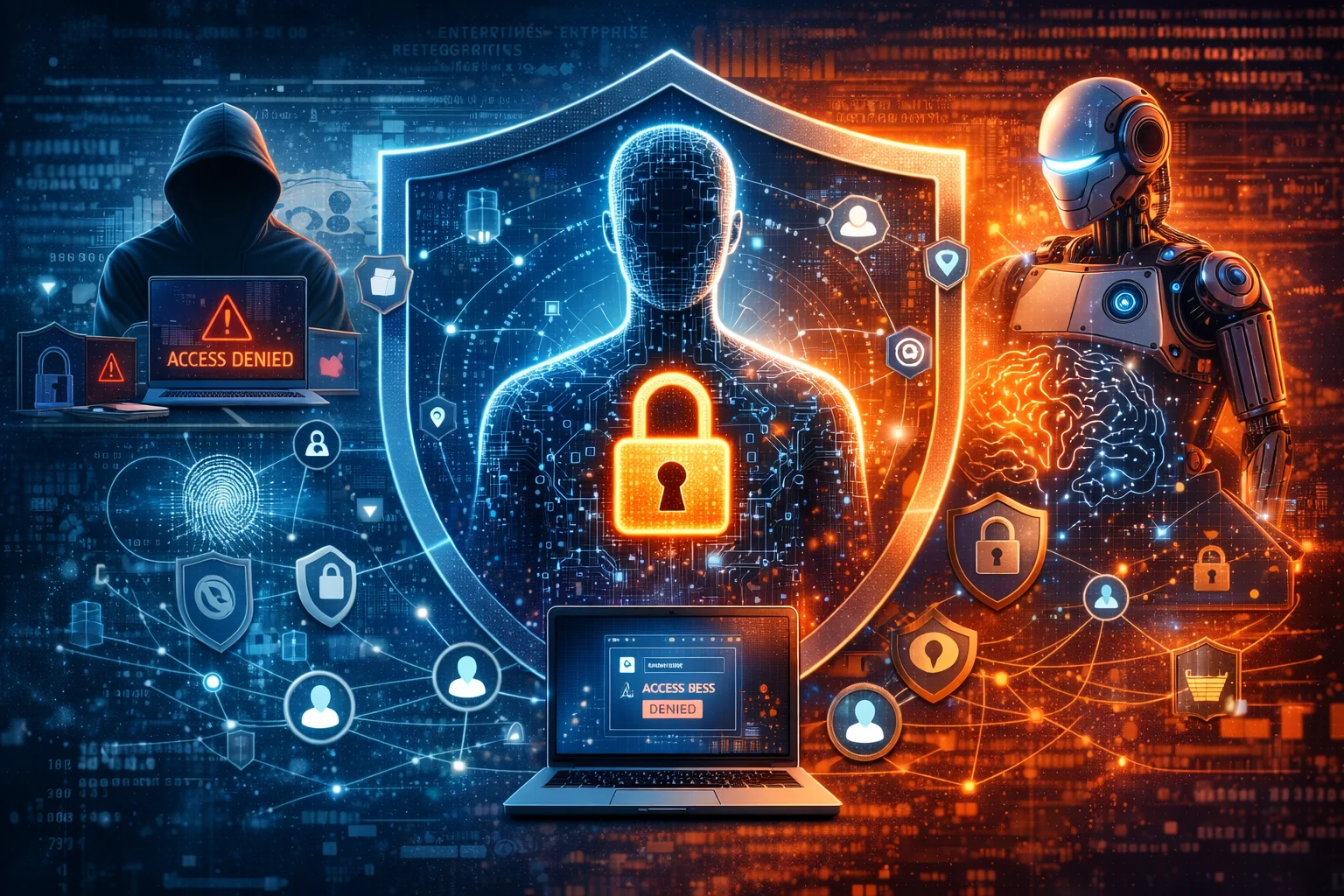
Identity, Sensors, and AIoT Intelligence Working as One
Why the Old Playbook No Longer Works
Digital transformation has fundamentally reshaped the enterprise attack surface. Hybrid work, cloud adoption, artificial intelligence, and billions of connected IoT devices have dissolved the traditional network perimeter, creating new opportunities alongside heightened cyber risk. Attackers increasingly exploit identities, connected devices, and fragmented tools rather than attacking well-defended networks directly. In response, a new security stack is emerging, one where identity, intelligent sensors, and Artificial Intelligence of Things (AIoT) operate as a single, connected system rather than a patchwork of disconnected tools. Identity establishes trust by verifying who and what is accessing a system, sensors deliver continuous visibility across cloud, endpoint, and physical environments, and AI converts the resulting flood of raw telemetry into timely, actionable intelligence. Together, these layers enable earlier detection, faster and more automated response, and materially stronger organizational resilience against an increasingly sophisticated threat landscape.

CISO, Head of Cybersecurity and IT Department
Blue Cloud Softech Solutions
The Perimeter Has Moved
For decades, cybersecurity centred on protecting the network perimeter through firewalls, antivirus tools, and VPNs. Cloud computing, remote work, SaaS platforms, and operational technology have changed how organizations function, and attackers have adapted accordingly, favouring stolen credentials and vulnerable endpoints over frontal assaults on hardened networks. This has made identity the new perimeter, pushing Identity and Access Management, multi-factor and passwordless authentication, and Zero Trust architectures to the centre of enterprise defense. Alongside this shift, organizations are deploying endpoint agents, IoT sensors, surveillance systems, environmental monitors, and network telemetry tools that generate continuous, high-volume streams of operational data around the clock. This data offers valuable visibility across both digital and physical environments, but on its own it is simply noise; its real strategic value emerges only when it is correlated and analyzed intelligently rather than viewed in isolation, department by department. This shift shows up clearly in the data: Verizon’s 2026 Data Breach Investigations Report found identity-related access — phishing, credential abuse, and pretexting combined — still accounts for over a third of confirmed breaches, while breaches involving a third party jumped 60% year-over-year to reach 48% of the total. The attack surface is no longer just what an organization builds; it is everything connected to it.
Bringing the Pieces Together
AIoT brings these strands together by combining AI with the data generated across connected devices and security platforms, correlating behavioral patterns and flagging anomalies in real time. For instance, if an employee authenticates successfully but their account also logs in from another country while on-site sensors detect unusual activity, AI can connect these signals instantly and trigger an investigation before damage occurs. Building this unified stack calls for security capabilities across several fronts: hardened infrastructure and network security to protect endpoints and traffic; robust data protection and privacy controls to safeguard sensitive information; secure cloud and DevSecOps practices to protect APIs and CI/CD pipelines; strong governance and regulatory compliance to enforce access and policy; managed SOC and threat response functions delivering continuous detection and analysis; and regular security assessments, forensics, and awareness programs to strengthen organizational resilience.
Woven together with identity-first access, least-privilege principles, and AI-driven automation, these capabilities create a proactive security model that anticipates threats rather than merely reacting to them.
This is no longer a future-state architecture. The same 2026 DBIR data shows AI-driven bot traffic on enterprise networks growing 21% month-over-month, even as human-led traffic stayed flat — a sign that the sensors, agents, and automated systems generating telemetry are multiplying faster than security teams can manually review them. Correlation is no longer optional; it is the only way to keep pace.
Where This Is Headed
The future of cybersecurity lies in intelligent integration rather than isolated point solutions. As AI capabilities mature and connected ecosystems expand, security platforms will increasingly combine identity intelligence, real-time sensor data, behavioral analytics, and automated response into a single adaptive framework. Autonomous security operations centres, predictive threat intelligence, and AI-assisted incident response are already emerging as the next frontier, helping organizations spot risk before it disrupts business and reducing the burden on stretched security teams. Enterprises that bring identity, sensors, and AIoT intelligence together, rather than managing them as separate initiatives, will be best placed to build adaptive, resilient, and future-ready security architectures. This unified approach protects both digital and physical assets, strengthens regulatory posture, and allows organizations to keep innovating with confidence even as the threat landscape continues to evolve.
Future Outlook
Organizations that fare best in the coming years will stop treating identity, sensors, and AIoT as separate budget line items and start treating them as one connected system. Expect AI to move from a purely detective role to a predictive one, anticipating anomalies before they become incidents. Regulatory expectations are also likely to catch up, pushing organizations to show that physical and digital risk are assessed together. Ultimately, the security stack of the future will be judged not by how many tools it contains, but by how seamlessly those tools reason about risk as a single, connected picture.
The Bottom Line
Identity establishes trust. Sensors provide visibility. AIoT delivers intelligent, unified response.
Authored by Ayub Shaik, CISO, Head of Cybersecurity and IT Department, Blue Cloud Softech Solutions Limited