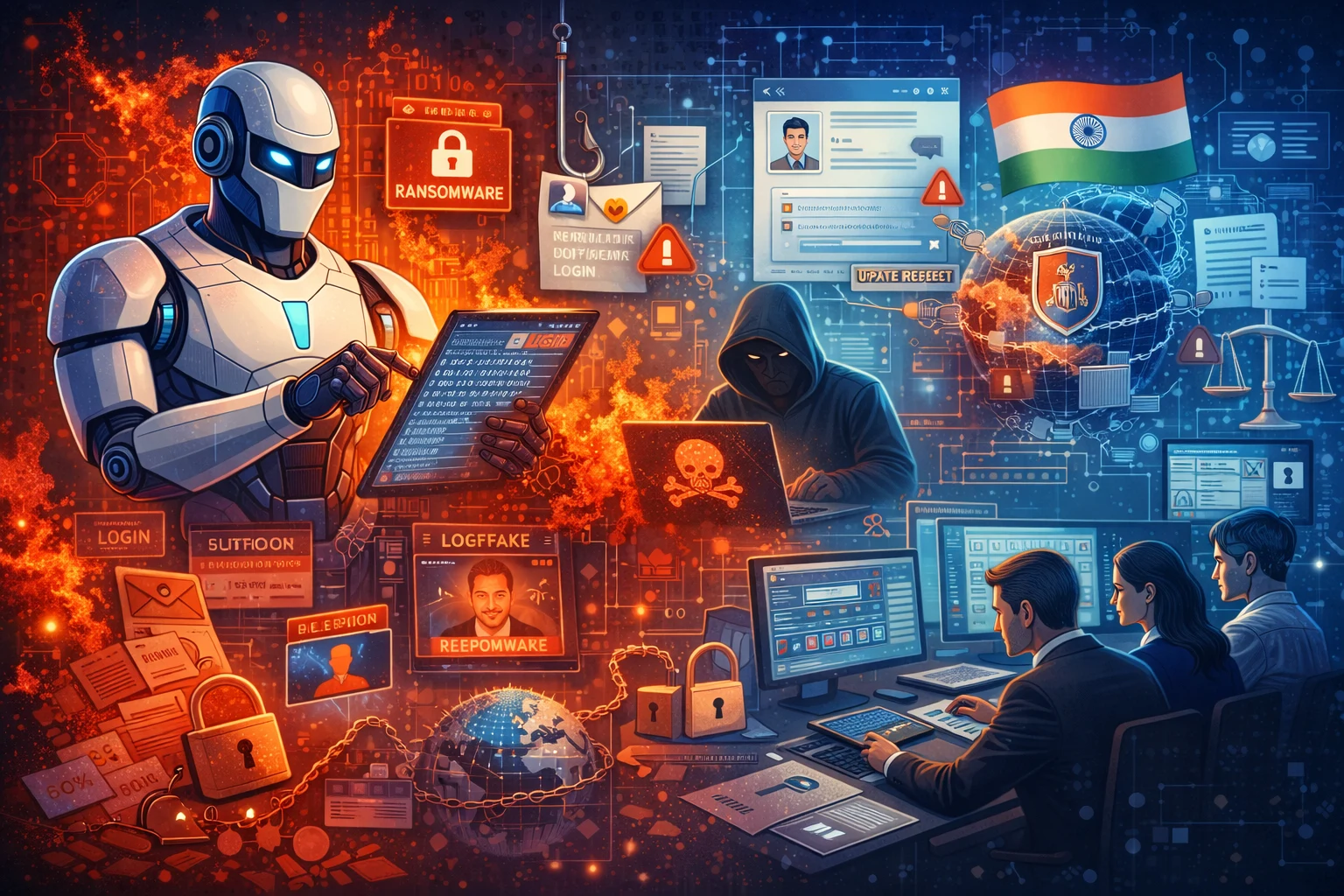
India’s cybersecurity battle is no longer fought only at the company gate. According to K7 Cyber Security’s Cyber Threat Monitor Report for Q2 2026-27, the central risk is that the next breach may arrive via a software update, a service provider, or a vendor account with legitimate access.
The big picture
The report puts India’s overall infection rate at 26%. Its central message is clear: supply-chain compromise is a structural risk. K7 points to three drivers: expanding digital ecosystems, crime-as-a-service platforms that lower the barrier to entry for attackers, and generative AI, which helps automate vulnerability discovery and personalize social engineering.
Who is most exposed
Textiles recorded the highest infection rate at 27%, followed by Consultants at 25%. FMCG, Hospitality, and Construction each accounted for 23%, while Government and IT/ITES accounted for 21% each. Banking (11%) and Food and Beverage (7%) fared best.
K7 offers a useful caution: infection rates alone do not prove supply-chain attacks. They show how exposed highly connected businesses are, and that exposure is the point. On vulnerabilities, IT/ITES led at 25%, followed by Manufacturing (19%) and Education (15%).
Cities tell two stories
Tier-1 cities such as Hyderabad (29%) and Delhi (26%) mostly see automated scanning, but the report warns that stealthy, targeted campaigns pose the greater danger. By contrast, Tier-2 cities look more fragile. Rajahmundry topped the list at 37%, followed by Kurnool and Visakhapatnam at 33% each. K7 says fast technology adoption has outpaced security basics there.
Old flaws, persistent damage
One of the report’s most striking findings is that weaknesses tied to MS17-010, the SMB flaw behind EternalBlue, still account for 73% of observed Windows threat activity, nearly a decade after Microsoft issued a patch. Alongside that, attackers increasingly use trusted Windows tools to hide their activity. Suspicious LOLBin executable writes led behavioral detections at 17%.
The report details the Weaxor ransomware chain, an evolution of Mallox. It begins with internet-facing SQL Servers, moves through PowerShell loaders and Cobalt Strike, and ends with encryption.
Phones and Macs are not safe havens
On mobile, Trojans account for 85% of detections, compared to 15% for adware. Within that mix, a single Trojan family that hides payloads in password-protected ZIP files holds the largest share (35%). K7 profiles the Octagon Android trojan, which poses as an emergency-services app, and the WhatsApp “boss scam,” where attackers hijack a CEO’s session to push fraudulent transfers.
On macOS, potentially unwanted applications make up 74% of detections. Within macOS Trojans, password stealers account for 72% and target credentials, cloud access, and developer secrets.
Vulnerabilities to watch
The report lists top flaws with MITRE ATT&CK mappings, including two rated CVSS 10.0, one in Oracle HTTP Server and WebLogic Server and one in SonicWall SMA1000 appliances. The implication is that these issues demand immediate attention because they sit at the highest severity level. It also covers issues in Microsoft IKE, SharePoint, Apple macOS, Apache Tomcat, WordPress, Cisco ASA/FTD and Google Pixel.
What organizations should do
K7 recommends four priorities:
- Map critical dependencies: know which suppliers, platforms and identities the business cannot run without.
- Rank by blast radius: prioritize suppliers by the impact their compromise would cause.
- Monitor third-party access: treat vendor accounts and integrations as potential attack paths.
- Rehearse supplier compromise: run incident-response drills that start with a trusted provider as the entry point.
The report’s closing line sums it up: the security perimeter is no longer a wall, but the ecosystem of relationships an organization chooses to trust. For Indian businesses, the lesson is clear: the real risk now sits in those relationships. Patch the old holes, and watch the people you let in.