
According to McKinsey, the global developer population is expected to reach nearly 50 million by the end of the decade. Given that building software has become more accessible than ever, the new challenge is no longer how to create products, but how to decide what is worth building.
Every company is racing to build the best AI model, whether it’s Anthropic, OpenAI, Google, Meta, or a Chinese company. Experts believe that Software as a Service (SaaS) will eventually be dead due to AI mass-producing and replicating traditional software companies.

PM
ThriveCart
However, Software has never been the moat for these companies. Slack doesn’t stop being Slack just because someone can produce it for cheaper. Ironically, Anthropic and OpenAI themselves use Slack; what’s stopping them from building it cheaper? That’s because software was never the moat. The moat lies much deeper and at various levels.
AI will produce more “Slopware” than software because of the lack of a moat we will discuss later in the article.
We have seen this happen before, in the dot-com boom or when the App Store created the ‘App economy’ software that became open to the masses. However, production and distribution were limited to those with technical knowledge, and the bar to produce software was still high with the qualified people who understood programming languages.
The Illusion of Access
AI today has opened up software development for everyone. You no longer need to have years of experience or technical training to build an idea into a working product. You can do it in an afternoon. However, the difference comes when you factor in access vs value.
More people building does not mean more problems are being solved. It means more software exists. The barrier to build has dropped, but not the use case of software. The builders who cut through are not the ones with the fastest tools; they are the ones who sat with the problem long enough to understand it. Who are they building for? What already exists. Why is it not enough? These are not technical questions. They are thinking questions, and no model answers them for you.
AI is doing the same with software. The tool has changed. The thinking required is not.
The rise of “slopware.”
“Slopware” accurately captures the shift. It does not mean the product is broken or unusable. It means the product is superficial; it is built because it could be, not because it should be. The issue is not technical execution. It is the absence of product thinking.
Many products today exist simply because the cost of building has collapsed.
Slopware is not only seen in the products that are being shipped but in the code it’s being built upon as well. A case study found that duplicated code grew 10x in just two years.
The Moat we talked about
There are two pillars when it comes to building any product. a) A technical pillar, b) a strategic pillar. The technical barrier represents the lengthy development cycles, costs, technical knowledge, and understanding, whereas the strategic pillar represents the problem being solved, understanding the perspective of the end user, and building something that stays in their life for a long time.
With AI, the technical barrier is collapsing. Apps are being built and shipped in a single day, and the cost is minimal. When a technical pillar collapses, the value remains in the more cognitive way of building the app. The strategic pillar is not a skill that an AI can replicate. It requires judgement, curiosity, and knowledge that you can get just by paying attention to people and their needs.
True access would mean people building what truly matters, solving real problems. Instead, we just produce. The gap between these two is where “slopware” lives.
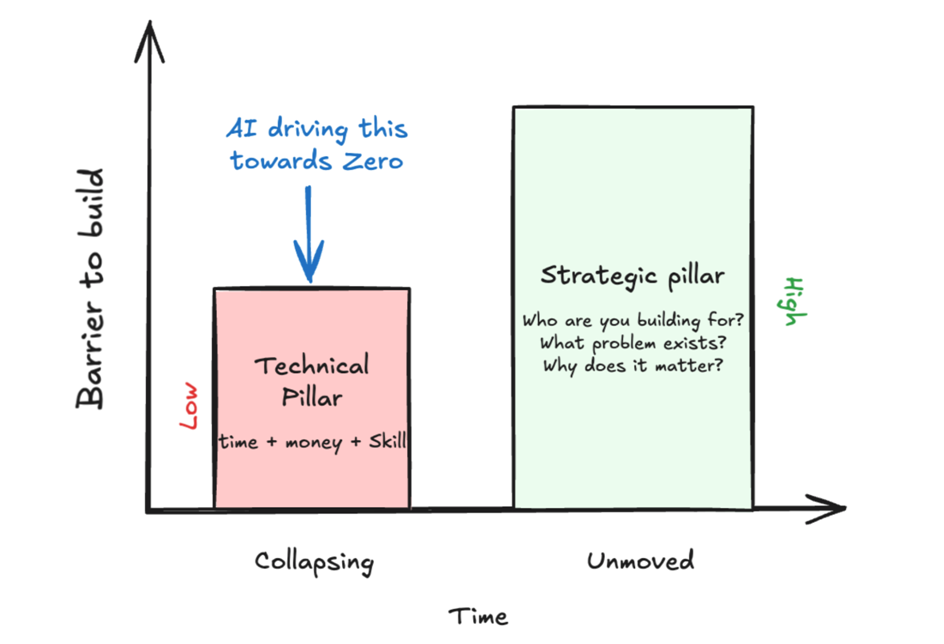
This is not the first time the technical pillar has seen such a threat, from mainframes to computers, from programming languages to drag-and-drop interfaces, from dev teams to solo founders. AI is simply the steepest drop yet. On the other hand, the strategy pillar stays strong. Understanding the target market, understanding the problem, understanding why it matters- the judgement becomes the new moat.
When models like Fable, ChatGPT 5.6 Sol, and Kimi keep getting more advanced, they not just accelerate development; they redefine where value sits. When building becomes trivial, judgment becomes decisive. The limiting factor is no longer technical ability, but the discipline to choose problems that matter, to define scope with precision, and to create products that endure beyond initial use.
This is the defining tension of the current era. Software is abundant, but meaningful software remains scarce. The proliferation of “slopware” is not a failure of technology, but a failure of selection.
The next generation of successful products will not be distinguished by how quickly they are built, but by how deliberately they are conceived. In that environment, judgment is not just a skill. It is the last defensible advantage.
Authored by Akshay Rana, PM, ThriveCart