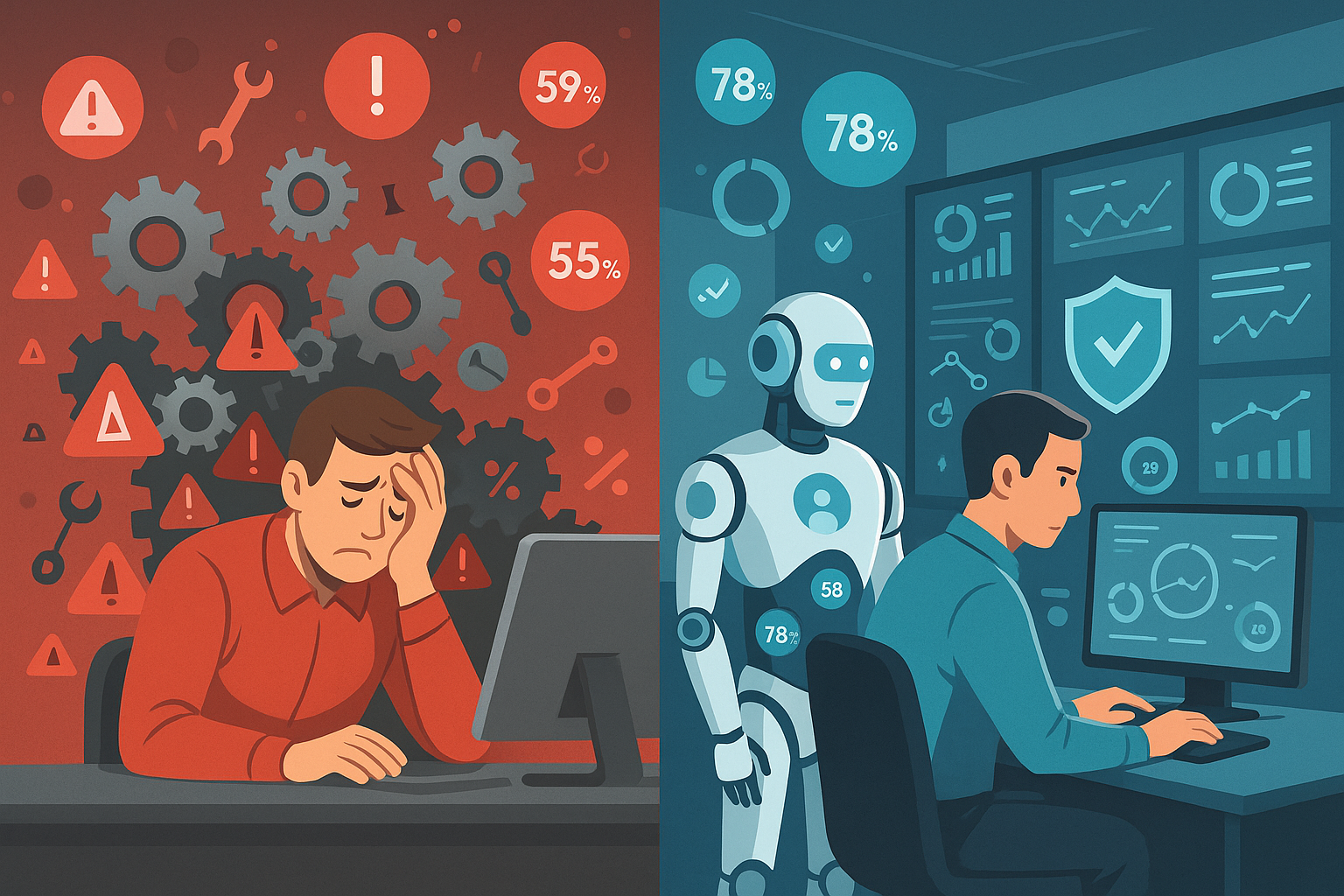
As 2025 draws to a close, India’s cybersecurity and digital risk landscape stands at a pivotal inflection point. What began as a decade of digital acceleration has now matured into an era of digital accountability—where resilience, trust, governance, and human judgment matter as much as innovation. For Indian enterprise CISOs, this year has been less about chasing the next shiny technology and more about answering more complex questions: Are our systems resilient by design? Can our people be trusted custodians of AI? And are we prepared for threats that blur the line between cyber, physical, and economic disruption?
Across sectors—from banking and payments to manufacturing, telecom, retail, and cloud services—2025 has underscored a simple truth: cybersecurity is no longer a function; it is a foundational capability. It underpins customer trust, operational continuity, regulatory compliance, and national digital ambitions. And as India looks ahead to 2026, CISOs are being asked to move from defenders of infrastructure to architects of digital confidence.
This year-end review brings together insights from industry leaders across cybersecurity, payments, AI, cloud, and enterprise technology to reflect on the defining shifts of 2025—and the strategic imperatives that will shape 2026.
2025: The Year Cybersecurity Became Strategic Infrastructure
One of the most significant shifts of 2025 has been the reframing of cybersecurity from a tools-driven discipline to a strategy-driven one. After years of vendor sprawl, overlapping platforms, and reactive investments, many enterprises reached a tipping point. Boards and CEOs no longer ask, “What security tools do we have?” but instead, “How resilient is our business?”
Rohit Aradhya, VP and Managing Director, App Security Engineering at Barracuda Networks, captured this shift succinctly. As enterprises grappled with AI-driven ransomware, polymorphic malware, and increasingly automated attacks, he noted that resilience could not be bought off the shelf.
“Tools don’t create cyber resilience, strategy does. For example, when AI becomes part of how you detect, respond, and learn, it transforms operations—it stops being an add-on. It becomes a force multiplier and helps to address sophisticated AI-driven ransomware attacks.”
In 2025, leading organizations began embedding AI not just in threat detection, but across the entire security lifecycle—correlating signals, prioritizing risks, and learning continuously from incidents. The result was faster response, reduced analyst fatigue, and a measurable reduction in dwell time. Yet, as Aradhya also emphasized, technology alone is insufficient.
“In an age of AI and quantum disruption, the best defence won’t be technology—it will be a security-aware culture of learning, agility, adaptability and purpose-driven talent.”
This cultural dimension became increasingly crucial as insider risks, misconfigurations, and human error continued to account for a significant proportion of breaches. CISOs in 2025 were forced to invest as much in people and processes as in platforms.
Digital Payments: Trust as the Cornerstone of Scale
Few sectors illustrate India’s digital success story better than payments—and few face cyber risks at a comparable scale. In 2025, India’s digital payments ecosystem entered a new phase of maturity. UPI volumes soared, UPI credit gained traction, RuPay cards strengthened their presence, and net banking continued to evolve. But scale also brought scrutiny.
Prakash Ravindran, CEO and Director at InstiFI, described 2025 as a defining year—one where trust finally caught up with innovation.
“2025 has been a defining year for India’s digital payments ecosystem. UPI’s rapid evolution, the rise of credit on UPI, increasing adoption of RuPay credit and debit cards, and the continued growth of net banking have collectively ushered the ecosystem into a new phase of maturity.”
A key enabler of this trust was Bharat Connect, India’s unified bill payment platform, which helped standardize and secure everyday transactions. Equally important were coordinated cyber-safety initiatives led by the RBI, telecom networks, and banks—demonstrating that systemic risk requires systemic defense.
“Coupled with stronger cyber-safety initiatives led by the RBI, telecom networks and banks, public trust in digital payments has deepened meaningfully.”
For CISOs in financial services, 2025 reinforced the reality that cybersecurity is inseparable from financial inclusion. Fraud prevention, real-time monitoring, identity assurance, and data protection are no longer back-end functions—they are core to user experience and national economic confidence.
Looking ahead, Ravindran sees digital payments evolving beyond convenience.
“Looking ahead to 2026, digital payments will move beyond speed and convenience to become a true enabler of opportunity.”
This next phase will demand even stronger security-by-design principles as interoperable, credit-driven, and cross-border payment models expand.
AI, Customer Engagement, and the Expanding Attack Surface
Another defining theme of 2025 has been the explosive convergence of AI, customer engagement, and data-driven personalization. Enterprises across retail, telecom, BFSI, and e-commerce leaned heavily on conversational platforms to engage customers at scale—often during high-pressure peak events.
Harsha Solanki, VP and GM Asia at Infobip, highlighted the sheer magnitude of this shift.
“This year has shown that AI is the core engine driving customer engagement. During peak events like Black Friday and Cyber Monday, our platform recorded a staggering 12.2 billion interactions globally, with RCS experiencing a 277% surge in messaging traffic on Black Friday alone.”
While these numbers reflect unprecedented scale, they also represent an expanded attack surface. Phishing, impersonation, account takeover, and data misuse increasingly hide within legitimate customer interactions. AI has enabled brands to deliver hyper-personalized experiences—but it has also raised the bar for security and compliance.
By 2026, Solanki expects AI-powered agents to manage the vast majority of routine interactions.
“By 2026, AI-powered agents are expected to manage up to 95% of routine interactions, providing instant and personalized support around the clock.”
For CISOs, this shift raises critical questions: How do you secure autonomous agents? How do you audit decisions made by AI? And how do you ensure trust when conversations, payments, and marketing converge on platforms like WhatsApp and RCS?
With regulations such as India’s Digital Personal Data Protection Act (DPDP Act) and updated telecom cybersecurity rules coming into sharper focus, 2025 forced organizations to rethink data governance not as a compliance burden, but as a trust enabler.
Operational Technology and the Cyber-Physical Reality
If 2024 was about IT security, 2025 firmly brought operational technology (OT) and cyber-physical risk into the spotlight. Manufacturing, logistics, and retail organizations accelerated digital adoption by deploying machine vision, RFID, mobile computing, and edge AI to gain real-time visibility.
Subramanium Thiruppathi, Director India and Subcontinent at Zebra Technologies, observed how deeply national initiatives shaped this momentum.
“In 2025, India has shown an incredible drive for digital adoption, with businesses across manufacturing, logistics, and retail rapidly implementing technologies like machine vision, RFID, and advanced mobile computing.”
While these technologies delivered efficiency and insight, they also expanded the threat landscape. OT environments—once air-gapped—are now connected, data-driven, and increasingly targeted by attackers.
Looking ahead, Thiruppathi sees 2026 as the year workforce augmentation becomes central.
“In 2026, India will enter a new phase of digital maturity where technology empowers its workforce like never before.”
Smart wearables, AI-driven guidance, and connected frontline systems will boost productivity—but they will also demand new security models that blend IT, OT, and human safety. For CISOs, this means collaborating more closely with operations, safety, and engineering teams than ever before.
From AI Pilots to Governed Execution
One of the clearest enterprise lessons of 2025 was the end of AI experimentation without accountability. After years of pilots and proofs of concept, boards and regulators began asking more challenging questions about return on investment, governance, and risk.
Vikram Bhandari, CTIO at Riveron, noted a decisive shift in enterprise conversations.
“In 2025, India’s enterprise technology landscape shifted decisively from experimentation to execution.”
AI is no longer treated as a discretionary innovation budget line—it is becoming foundational infrastructure. This has profound implications for cybersecurity. As Bhandari explained:
“Technology and finance leaders are beginning to treat AI as foundational infrastructure, supported by deeper investments in cloud, data platforms, and cybersecurity.”
For CISOs, this means embedding security, controls, and compliance into AI systems by design—rather than retrofitting them after deployment. The focus is moving toward orchestrated, end-to-end operations where trust is engineered into workflows.
Cloud Agility Versus Infrastructure Resilience
While cloud-first strategies dominated boardroom agendas in 2025, the year also served as a reminder that resilience depends on balance. Outages, misconfigurations, and supply chain dependencies exposed the risks of over-reliance on any single model.
Ajay Sawant, Chairman & Managing Director at Orient Technologies, highlighted this duality.
“As organisations prepare for 2026, enterprise technology is entering a period of accelerated evolution driven by cloud-first architectures, AI-powered automation, and the rapid build-out of digital public infrastructure.”
At the same time, Sawant emphasized that traditional infrastructure still plays a critical role in stability and performance. For CISOs, the implication is clear: security architectures must seamlessly span hybrid, multi-cloud, and on-prem environments—without creating blind spots.
AI Scale Meets Security and Resilience Demands
As AI adoption accelerated across sectors in 2025, so did expectations around resilience. Tejesh Kodali, Group Chairman of Blue Cloud Softech Solutions, described the year as one of parallel acceleration and pressure.
“2025 highlighted both the promise of AI and the mounting pressures felt across sectors—from security and cybersecurity to healthcare and beyond.”
The challenge, he noted, is moving away from fragmented, reactive approaches toward integrated, AI-powered frameworks that can adapt continuously. For CISOs, this means rethinking architecture—not just tools—to support long-term trust and reliability.
Fixing the Fundamentals: From AI Spend to AI Impact
Despite massive investments, many organizations discovered in 2025 that the AI impact does not scale without firm foundations. Poor data quality, skills gaps, and rushed deployments often stalled progress.
Dr. Mukesh Gandhi, Founder & CEO of Creative Synergies Group, offered a sobering reminder:
“AI adoption will continue to accelerate in 2026, yet meaningful transformation requires more than just investment in next-generation infrastructure. It demands a relentless focus on the fundamentals.”
For CISOs, this means ensuring data integrity, model governance, and operational discipline—before pursuing transformational outcomes.
The CISO Mandate for 2026
As 2025 closes, one message rings clear: cybersecurity is no longer about preventing breaches alone. It is about enabling trust at scale. In 2026, Indian CISOs will be expected to:
• Embed security into AI, cloud, and digital public infrastructure by design
• Balance innovation with resilience across IT, OT, and human systems
• Translate regulation into competitive advantage through trust
• Build security-aware cultures, not just secure architectures
The year ahead will not be defined by the absence of attacks—but by the presence of preparedness. And in that preparedness lies the accurate measure of cyber leadership.