
Enterprise AI in India has crossed an inflection point; the question is no longer whether to adopt it, but why so many initiatives stall at the proof-of-concept stage. In contrast, others scale into measurable business outcomes. As CIOs face mounting pressure to justify AI spend in terms of tangible returns, the answer increasingly lies beneath the surface: in hybrid architectures, data governance, and power-hungry infrastructure built for tomorrow’s workloads rather than yesterdays compute assumptions. With agentic AI adoption accelerating and attack surfaces expanding in tandem, CISOs and CIOs alike are being forced to rethink zero-trust design, model lifecycle governance, and sustainable cooling strategies almost simultaneously. In this conversation, Srinivas Rao, Managing Director, Infrastructure Solutions Group (ISG), Lenovo India, unpacks what separates enterprises industrializing AI successfully from those still stuck in experimentation — and what leadership priorities will define the next three to five years.
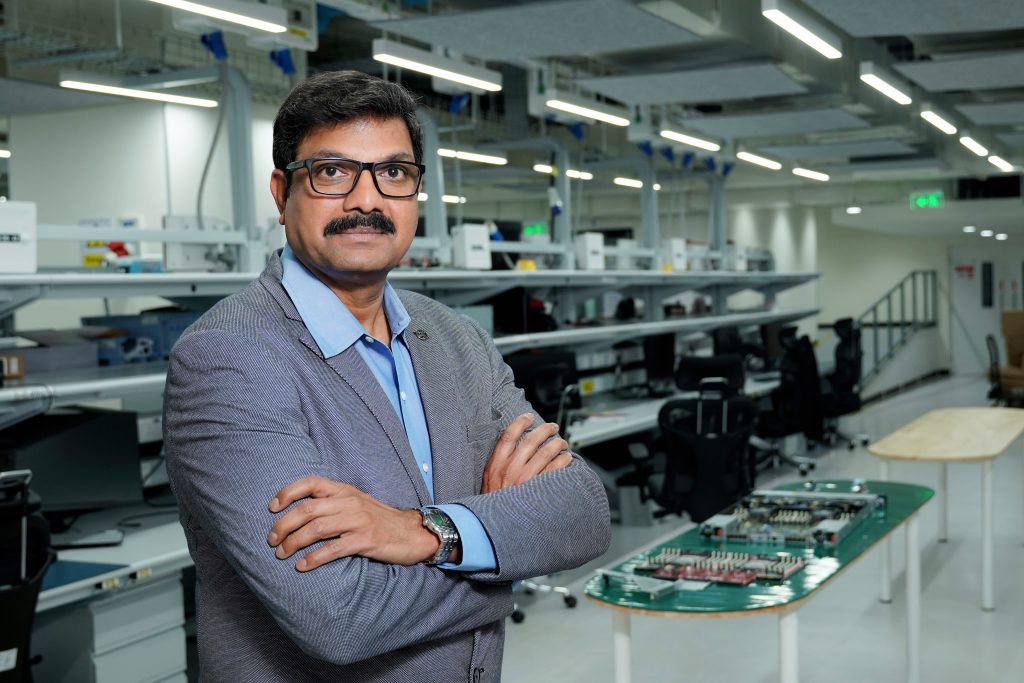
Managing Director,
Infrastructure Solutions Group (ISG),
Lenovo India
CISO Forum: Enterprise AI has moved from experimentation to execution. In your interactions with customers across India, what distinguishes organizations that are successfully scaling AI from those that remain stuck in pilot mode?
Srinivas Rao: The difference is not the ambition. A lot of enterprises have this ambition to really have AI rolling into their business operations. But it’s their ability to operationalize AI that makes the big difference between organizations.
Primarily, if you look at people who have been successful in their journeys, they really focus on four important characteristics.
One is a business-first approach. They start with very well-defined use cases, specifying the measurable outcome they expect to achieve by deploying this AI solution in their business environment.
The second important characteristic that we have seen is data readiness. Most organizations have the ambition. They want to achieve something, some use case, but high-quality data governance has been the biggest lagger in really operationalizing that.
The third important characteristic is implementing the right architecture. Today, the hybrid AI architecture plays a very, very important role. Specifically, deploying AI where it makes more sense: on premises, in the cloud, or sometimes at the edge as well. Based on performance and latency, you need to implement this hybrid AI architecture for the applications.
Lastly, the fourth characteristic I have seen enterprises move from POCs to successful case studies is cross-functional ownership and collaboration. That has become a very, very important aspect of AI initiatives, involving business leaders, the IT team, and the operations team, and ensuring that all these teams come together to really deliver the business outcome.
So, these are the four characteristics that really differentiate organizations running a pilot project from those succeeding in their AI journey.
CISO Forum: CIOs are under pressure to justify AI investments with measurable business outcomes. What framework should enterprises use to evaluate AI ROI beyond productivity gains, particularly in areas such as revenue growth, customer experience, risk reduction, and operational efficiency?
Srinivas Rao: There is no secret framework. It is a well-known framework that everyone needs to follow, specifically for evaluating AI investments across four dimensions.
One is revenue growth. How is this investment helping customers personalize the experience, accelerate product development, and create new AI-enabled services? Today, users like you and me are always looking for new AI services that make our operations easier. That is more important.
The second important thing is customer experience. How do you keep this engagement with the respective customers? As response times improve and satisfaction scores rise, the more satisfied customers are with the architecture and governance organizations are putting in place, the more they will expand their business as well.
And, of course, operational efficiency in terms of lowering infrastructure costs, optimizing the supply chain, and automating repetitive tasks.
In fact, we surveyed these CIOs, and in India specifically, we found that almost 95% expect a positive ROI from these AI investments. They expect almost a $3 return for every dollar they invest.
So today, the framework is very well-defined, with a clear objective: for every dollar they invest, they get almost $3 in return.
CISO Forum: As AI workloads grow more complex and data-intensive, how should CIOs rethink their infrastructure strategy? What are the key characteristics of an AI-ready enterprise architecture in 2026 and beyond?
Srinivas Rao: One needs to look at a hybrid-by-design infrastructure that supports data sovereignty and workload flexibility. Not every workload sits in the cloud, and if someone is considering data sovereignty, it is important to have a hybrid design, which will play a very, very important role in 2026 and beyond.
The second important thing is having the right kind of infrastructure: accelerated compute infrastructure. The compute infrastructure has been changing drastically. Having an accelerated compute platform, not only with the right kind of processing technologies but also the right kind of GPUs, with future sustainability to scale the workloads they are anticipating.
The third important thing is that when you are looking to put this hybrid cloud AI infrastructure in place, you must look to the future and consider how you can apply this infrastructure across edge-to-cloud environments. There might be many applications that require low latency. Going with an edge architecture integrated with the cloud architecture on the centralized side plays a very important role.
The fourth and very important thing is the power and cooling strategy they put in place for their future AI.
If you look back about a decade, a typical enterprise server consumed only a few hundred watts of power. Today, AI-optimized GPU servers can consume several kilowatts each, and AI racks are reaching power densities of tens of kilowatts and beyond. As a result, traditional air cooling alone is becoming insufficient for many high-density AI deployments, making liquid cooling increasingly important.
You need to have sustainable liquid-cooling infrastructure in place to truly scale to meet future AI requirements truly truly.
That way, Lenovo has been visionary in bringing liquid-cooling technologies to market, with sixth-generation liquid-cooling technologies dating back to 2012, across many HPC and AI environments. We have proven technologies that meet not only current hybrid requirements but also future ones.
CISO Forum: Many organizations are adopting hybrid approaches that combine on-premises, cloud, and edge environments. How do you see the balance between these deployment models evolving for AI workloads, especially in highly regulated sectors such as BFSI, healthcare, and government?
Srinivas Rao: One thing is very, very clear: the future is hybrid cloud. There is no second thought on that.
The cloud will continue to provide that elasticity for training and burst-capacity workloads. When you talk about training workloads, they require burst I/O workloads. So, the cloud will provide that agility.
However, on-premises AI will become increasingly important for regulated industries, particularly where data governance is critical, and performance and predictable costs are essential considerations. The on-premises AI cloud infrastructure plays a very, very important role.
Lastly, wherever applications require low-latency datasets, edge computing can play a very big role.
So, when someone is looking at this hybrid AI cloud infrastructure, they need to consider the entire strategy from edge AI to the cloud, ensuring an architecture that addresses not only low-latency applications but also data sovereignty requirements.
Specifically, when you talk about BFSI, they expect sensitive data and mission-critical inference workflows to be stationed in the private cloud. While they would love to keep some of the experimental data and related workloads in the public cloud, they don’t know what kind of burst capacity may be required.
In fact, if I had to talk about a reference customer, last week I was in a meeting with a pharmacy customer who runs all their experiments on public cloud infrastructure. But finally, when they had to deploy in the production environment, they deployed it in their own private cloud, where today they can successfully meet not only the current workloads but also future AI workloads by running this hybrid architecture.
CISO Forum: Security leaders are increasingly concerned about the expanded attack surface created by AI systems. What new infrastructure and security considerations should CISOs prioritize when deploying and operating AI at scale?
Srinivas Rao: Zero-trust architecture.
If you understand zero trust architecture, never trust any data source or any device unquestioningly. Always validate the data. So, I recommend adopting a zero-trust architecture across the AI infrastructure, including devices, data models, and inference data. Always use a zero-trust architecture across your entire AI framework.
The second important thing is: how do you protect against model poisoning and prompt injection attacks? There are a lot of problems when you start running inference workloads. There are attempts to inject poisoning prompts into the models, and these are things CISOs need to consider.
The third important thing is: how do you provide data security and encryption across the entire data lifecycle? Right from the time the data is created, to the time it is ingested into the model, and while it is being fine-tuned, how do you provide security and encryption across the entire AI lifecycle?
And, of course, continuous monitoring and observability of the AI systems will also play a very, very important role. Once the entire infrastructure is in place and the zero-trust architecture is in place, observability plays a very important role.
These are a few important parameters to consider when designing AI at scale in enterprises today.
CISO Forum: Governance and trust are emerging as board-level concerns. How can enterprises build governance frameworks that address data quality, model transparency, compliance, and responsible AI without slowing innovation?
Srinivas Rao: With the evolving functional groups within organizations, it is important to have a cross-functional AI governance framework that involves legal, compliance, business, and technology teams to ensure the enterprise builds a proper governance framework as it builds the entire AI infrastructure for its operations.
Second is the data governance framework.
I have seen organizations fail when they don’t have a data governance framework. The data governance framework includes addressing biases, which involves manual intervention by the teams and related processes. So, the data governance framework plays a very important role within the overall governance framework when innovating with AI solutions.
At some point, enterprises also need to consider how they manage the model lifecycle. Today’s model might not be self-sufficient for the next generation of innovation. How do you manage the entire lifecycle of the models? That is important.
A risk-based approach enables rapid innovation while ensuring that trust and regulatory compliance remain at the core of the entire framework as solutions are designed within organizations.
CISO Forum: The industry is now talking about agentic AI and autonomous decision-making systems. What practical steps should organizations take before introducing agentic AI into critical business processes, and which risks should be addressed first?
Srinivas Rao: Based on my experience, I’ve seen many organizations dive into agentic AI.
If we look at the numbers, India is among the fastest-growing markets for agentic AI solutions, with the focus on agentic AI projected to increase by more than 140% over the coming year.
The key parameters that will really define the success of agentic AI are how well you have designed your hybrid AI architecture and how well you have put the inference infrastructure within your organization. That will be the key parameter for the value someone gets from really adopting agentic AI.
Importantly, while this has become so autonomous, there still need to be checkpoints to monitor whether it is going in the right direction. While I really appreciate the way autonomous agents are coming into place, where they make decisions on their own and all those things, there are still places where you need checkpoints to make sure they are in line with the organization’s requirements. It is important to continuously monitor decisions to ensure you remain aligned with the entire framework.
If I must summarize, agentic AI holds tremendous promise, but trust and guardrails must precede autonomy rather than just allowing it to make decisions on its own. That’s the kind of suggestion that I keep giving to customers as well.
Moreover, the infrastructure plays a very, very important role. Having an intention and a business outcome alone is not sufficient. Having the right kind of infrastructure running at the edge and even in the private core plays a very, very important role.
CISO Forum: BFSI organizations are among the most advanced AI adopters. Based on Lenovo’s experience, which AI use cases are delivering the strongest business value today across areas such as fraud prevention, risk management, compliance, customer engagement, and operations?
Srinivas Rao: I would not say one is playing a more important role than the others, but from a productivity and business perspective, fraud management and fraud prevention are the number one priority within BFSI organizations.
Over and above that, risk management and compliance are also among the biggest use cases, making a big impact within BFSI organizations.
For example, in compliance, automated KYC and AML monitoring have become much smoother with AI coming into the picture. You yourself may have experienced it when you go to some of these banking environments. The way the entire process has been automated using automated KYC and AML systems has made a significant difference.
While I will not be able to prioritize all the use cases, if you ask me, the number one use case that is making the biggest impact is fraud prevention. That remains the number one priority for banks.
Of course, there are customer engagement use cases that also play a big role, but if I had to pick one, it would be fraud prevention.
CISO Forum: AI transformation is often discussed as a technology challenge, but organizational readiness can be equally important. What changes do CIOs need to make in operating models, talent strategies, and cross-functional collaboration to industrialize AI successfully?
Srinivas Rao: Scaling AI requires organizational change alongside technology investment. There are very, very important considerations one must make.
For example, CIOs should focus on creating AI Centers of Excellence within their organizations. You might have already seen or heard about many GCCs entering India and setting up Centers of Excellence within their organizations, which bring data scientists and domain experts together to experiment and then create production-ready infrastructure and use cases. That is one important thing CIOs need to focus on.
The second thing is upskilling employees in AI literacy and data engineering. That makes a very, very important difference if you must become successful in developing new AI within enterprises.
If you don’t create the Center of Excellence, you really don’t know where you are headed. And if you don’t upskill your employees, again, you don’t know whether they are aligned with what you are doing or following it. That is an important parameter.
The third important thing is embedding AI into business workflows.
Many organizations have legacy workflows. How do you embed the entire AI architecture into these legacy workflows? That plays a very, very important role.
These are the key parameters CIOs need to focus on to industrialize AI successfully.
CISO Forum: Looking ahead three to five years, how do you see enterprise AI reshaping IT leadership priorities? What capabilities should CIOs and CISOs start building today to remain competitive in an increasingly AI-driven business environment?
Srinivas Rao: The priorities will shift towards building AI factories. That will become a very, very important parameter.
Earlier, the discussions were more about how much compute infrastructure you were providing. But today, the discussion is about the AI infrastructure and AI factories you have been creating in your environment. That will be the focus going forward.
The second thing is managing AI economics. That will play a very, very important role. When I talk about AI economics, it is not only about investments but also about how sustainable the infrastructure you deploy is and how energy-efficient it is.
The third important parameter I foresee going forward is that, while many enterprises are on this journey and want to accelerate it, these investments are all CapEx-intensive. How are organizations coming forward to help them manage these CapEx investments?
On that front, Lenovo has introduced an approach called TruScale, which provides GPU infrastructure-as-a-service to banking and financial customers. They don’t have to make upfront CapEx investments. Instead, as they deploy the architecture and start consuming the infrastructure, they pay based on usage.
These are the three or four key parameters that will play a major role in shaping CIO priorities going forward.
Lastly, the ecosystem.
Organizations alone will not be able to deliver the kind of outcomes required. How well they build the partner ISV ecosystem will be very important.
On that front, Lenovo has the AI Innovators Program, which includes more than 60 ISV vendors with diverse use cases across verticals.
CIOs will also focus on OEMs with strong partnerships within ISV ecosystems, as these partnerships will help them succeed.
These are the important priorities going forward: building AI factories and hybrid AI platforms, managing AI economics through sustainable, efficient technologies, and creating a strong partner ISV ecosystem. Those with a strong ISV ecosystem are the ones CIOs will be focusing on going forward.